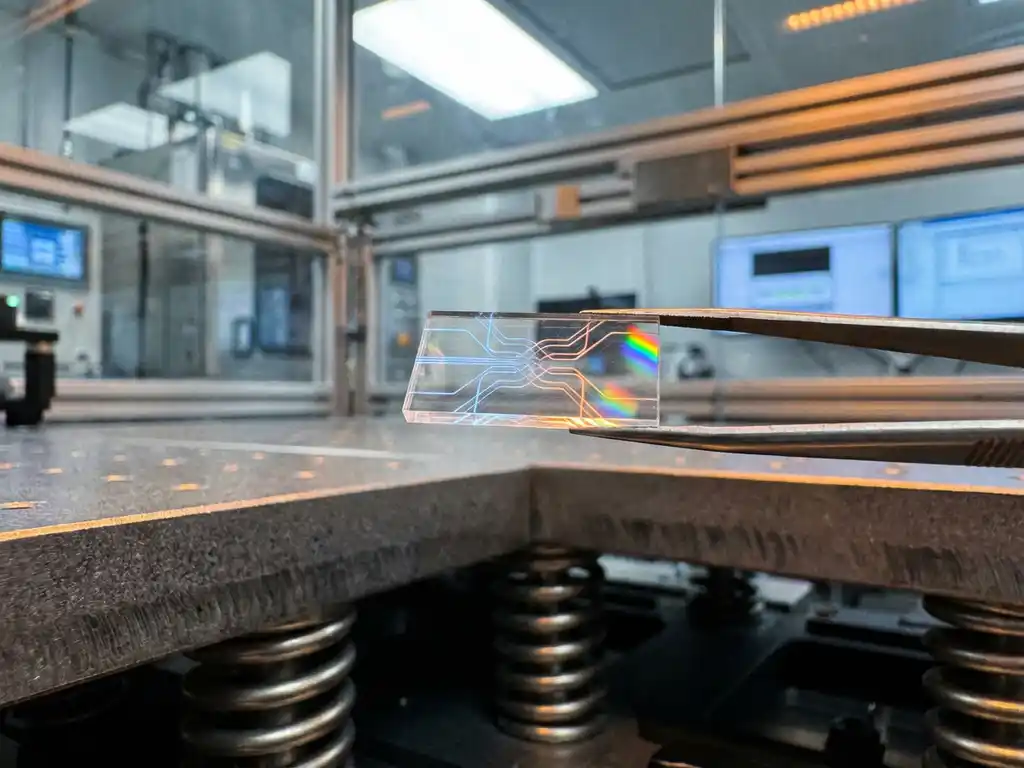
Photonic chips use light instead of electrons to process and transmit information, making them highly capable for next-generation applications in communications, sensing, and computing. However, because they rely on precise optical pathways, even small mechanical disturbances can significantly affect their performance.
Understanding how photonic chips respond to vibration is crucial for engineers and manufacturers working with integrated photonics, especially in mobile applications, automotive systems, and industrial environments where mechanical stability cannot be guaranteed.
What Makes Photonic Chips Sensitive to Vibration?
Photonic chips are sensitive to vibration because they rely on precisely aligned optical pathways in which light travels through waveguides with tolerances measured in nanometers. Any mechanical movement can disrupt these optical connections, causing signal loss, phase shifts, or a complete breakdown in communication between photonic components.
This sensitivity stems from several fundamental characteristics of integrated photonics. Light waves in photonic chips must maintain specific phase relationships and coupling efficiencies between different optical elements. When vibration occurs, it can cause micro-movements in the chip structure, altering the refractive index of materials or changing the physical dimensions of waveguides.
Different photonic chip platforms show varying degrees of vibration sensitivity. Silicon photonics chips, built on silicon-on-insulator substrates, tend to be more mechanically robust due to silicon’s material properties. However, indium phosphide platforms, while offering superior optical performance for active components, can be more susceptible to mechanical stress due to the material’s brittleness.
Temperature fluctuations caused by vibration-induced mechanical stress can also affect photonic chip performance. The thermo-optic effect in materials such as silicon nitride means that even small temperature changes can shift the optical properties of waveguides, affecting signal transmission quality.
How Do Photonic Chips Resist Mechanical Vibration?
Photonic chips resist mechanical vibration through robust packaging designs, mechanical isolation systems, and structural engineering approaches that minimize vibration transmission to sensitive optical components. These solutions range from chip-level design modifications to system-level vibration-damping strategies.
At the chip level, designers implement several strategies to improve vibration resistance. Symmetric layouts help distribute mechanical stress evenly across the chip surface. Wider waveguides and larger bend radii provide greater tolerance for small positional changes. Some designs incorporate redundant optical paths that maintain functionality even if primary routes experience vibration-induced disruptions.
Packaging plays a critical role in vibration resistance for photonic integrated circuits (PICs). Advanced packaging techniques include using low-stress materials that absorb mechanical energy before it reaches the photonic components. Hermetic sealing protects against environmental factors while providing structural stability. Some packages incorporate active vibration-cancellation systems for extremely sensitive applications.
System-level approaches focus on isolating the entire photonic module from external vibration sources. This includes mounting photonic chips on vibration-damping substrates, using flexible interconnects that accommodate movement without breaking optical connections, and implementing feedback systems that can compensate for vibration-induced signal changes in real time.
What’s the Difference Between Vibration Testing for Photonic vs. Electronic Chips?
Vibration testing for photonic chips requires more stringent protocols and different measurement parameters than testing for electronic chips because photonic devices must maintain precise optical alignment and signal quality, not just electrical continuity. Electronic chips typically pass vibration tests if they maintain electrical function, whereas photonic chips must preserve complex optical characteristics.
Electronic chip vibration testing primarily focuses on mechanical integrity, solder-joint reliability, and maintaining electrical connections under stress. Test parameters typically measure resistance changes, signal-timing variations, and complete functional failure points. Testing often uses standard acceleration levels and frequency ranges defined by automotive or aerospace standards.
Photonic chip testing requires additional optical performance metrics throughout vibration exposure. Engineers must monitor insertion loss, optical return loss, wavelength stability, and phase coherence while subjecting chips to mechanical stress. These optical parameters can degrade significantly before any mechanical failure occurs, requiring more sensitive detection equipment.
The frequency ranges for photonic chip vibration testing often extend into higher bands because optical components can be sensitive to resonances that do not affect electronic circuits. Additionally, photonic chips require testing under operational conditions with active optical signals, whereas electronic chips can often be tested in passive states.
Environmental chamber requirements also differ, as photonic chips may need simultaneous temperature, humidity, and vibration testing to understand how multiple environmental factors interact with optical performance in ways that purely electronic systems do not experience.
How Do Environmental Vibrations Affect Photonic Chip Performance?
Environmental vibrations affect photonic chip performance by causing micro-displacements in optical components, leading to increased insertion loss, wavelength drift, polarization changes, and degradation of the signal-to-noise ratio. The severity of the impact depends on vibration frequency, amplitude, and the specific photonic chip platform being used.
Low-frequency vibrations, typically below 100 Hz from sources such as building movement or large machinery, tend to cause gradual shifts in optical alignment. These slow changes can often be compensated for by feedback control systems, but they may require periodic recalibration in sensitive applications such as precision sensing or quantum communication systems.
High-frequency vibrations, often from cooling fans, motors, or acoustic noise, can cause rapid fluctuations in optical performance. In communication applications, this manifests as increased bit error rates or reduced signal quality. In sensing applications that use photonic chips, high-frequency vibrations can introduce noise that masks the actual signals being measured.
The PhotonDelta ecosystem addresses these challenges through comprehensive testing and design optimization across the integrated photonics value chain. From initial chip design to final packaging and application development, ecosystem partners work to ensure photonic chip technology can meet the vibration requirements of demanding applications such as automotive LiDAR systems and portable medical devices.
Different applications have different vibration-tolerance requirements. Data center applications may only need to handle building vibrations and cooling-system noise, while automotive applications must survive engine vibrations, road conditions, and crash scenarios. Portable medical devices require photonic chips that maintain accuracy despite handling and transportation stresses, making vibration resistance a key enabling technology for the widespread adoption of integrated photonics solutions.
As the field of integrated photonics continues to evolve, addressing vibration challenges becomes increasingly important for real-world applications. The development of robust photonic chips requires close collaboration between chip designers, packaging engineers, and application developers to ensure optimal performance across diverse operating environments. Through strategic funding initiatives and comprehensive human capital development, the industry continues to advance solutions that make photonic technology more resilient to mechanical disturbances. The ongoing efforts in internationalisation help share best practices and testing methodologies across global markets, while fostering an innovative ecosystem that drives the next generation of vibration-resistant photonic solutions forward.